
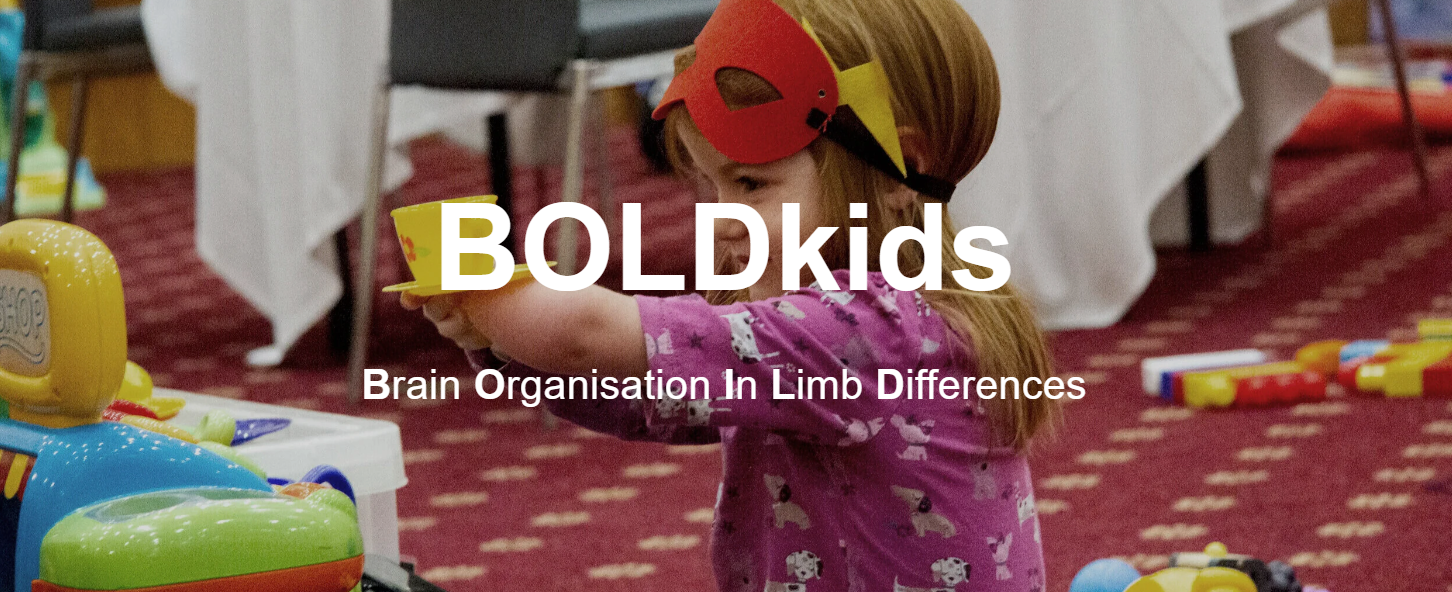
Learning from children: designing the next generation of wearable technology
Children with limb differences may develop different ways of moving and interacting with the world around them. By exploring how they use a wearable robotic device, we hope to learn from their movement strategies and experiences to design future wearable technologies.
Our study asks:
How do children learn to use the device?
Do children with an upper limb difference use it in different ways?
What can their movements and ideas teach us about the design of future assistive and wearable technologies?
What are we doing?
We are working with children both with and without upper limb differences. Each child learns to use the wearable supernumerary device that adds an extra way to grasp and interact with objects. They then complete a series of games and tasks.
We look at how they complete the tasks and use motion tracking to study how different parts of the body work together. This helps us understand not only whether a task is completed, but also how each child finds a way to do it.
We are also working with a smaller group of adults, both with and without upper limb differences, to explore whether the differences in movement strategies we observe in children are also present in adults.
Listening to children’s ideas
Movement tells us only part of the story.
After trying the device, children with an upper limb difference also take part in a one-to-one co-design session. This means that they help us think about how the technology could be improved.
We explore questions such as:
Is the device comfortable and easy to wear?
What would they change about its shape or position?
How would they like to control it?
What activities would they use it for?
What should an extra robotic body part look like — and even what should we call it?
These are interactive sessions, rather than just interviews. Children can try things, show us their ideas and suggest changes. This gives them different ways to communicate what matters to them and puts their experiences at the centre of the design process.
What are we learning so far?
Our early observations suggest that children with and without upper limb differences may use different combinations of their hands, arms and trunk when learning to use the device.
We are now nearing the end of data collection. Our next step is to look more closely at these movement patterns and understand what might explain the differences we observe.
What have children and families taught us?
Our co-design sessions have already given us many ideas.
Children and adults with upper limb differences bring valuable lived experience to the design process. Their feedback is shaping our ideas about what activities the device could be designed for, how it could be controlled, and even its shape and functionality.
These conversations have encouraged us to move beyond a one-size-fits-all approach. Instead, future technologies could focus more on what each person wants to do and how they already move. Flexible, modular designs, where different parts or functions can be adapted to individual needs, may be one way forward.
Designing useful technology is not only about helping someone complete a task successfully. We also need to consider how naturally a device fits with the movement strategies they have already developed, while preserving their existing abilities, such as their sense of touch.
We will use qualitative research to look systematically across the children's and adults' experiences and identify common themes, differences and priorities. Together with our movement data, this will help guide the next generation of wearable and assistive technologies.